
Introduction
Electric vehicles (EVs) are accelerating the transition to low‑carbon transportation. However, with millions of EVs entering the market, a parallel concern arises: what happens to their batteries once they degrade below automotive performance requirements? Rather than relegating these batteries to landfill or immediate recycling, second‑life EV batteries present a sustainable, eco‑friendly energy solution that aligns with circular economy principles.
What Are Second‑Life EV Batteries?
When an EV battery’s capacity drops to approximately 70–80 % of its original level, it may no longer meet the range and power demands of automotive use. However, significant usable capacity often remains, making these batteries excellent candidates for non‑vehicular energy storage applications. This remaining capacity can be harnessed to support stationary energy systems, thereby extending the functional life of the battery and reducing waste.
EV Battery Life Cycle and Second Life
The typical life cycle of an EV battery can be conceptualized in phases:
- First Life: Battery powers the EV until its automotive performance diminishes.
- Second Life: Battery is repurposed for energy storage, grid support, or other stationary applications.
- Recycling: Once the battery can no longer reliably serve secondary purposes, it is recycled to recover critical materials.
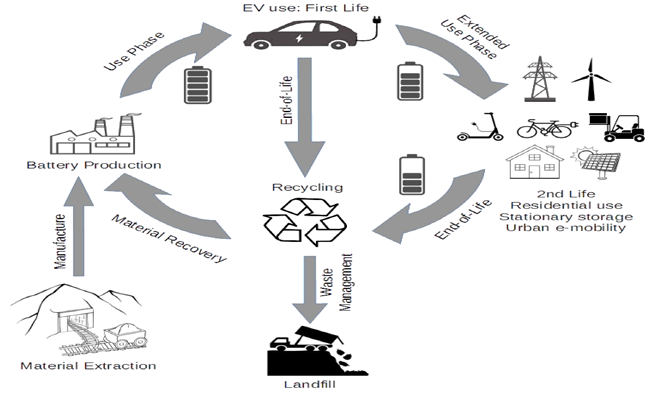
Figure 1: Lifecycle of an EV battery, showing the transition from first life to second life and eventual recycling.
Applications of Second‑Life Batteries
1. Renewable Energy Storage
Second‑life batteries are particularly well‑suited for storing intermittent renewable energy (e.g., solar and wind). They can buffer excess generation during peak production periods and discharge stored energy when demand is high. This capability enhances grid reliability and facilitates greater integration of renewables.
2. Grid Services and Stability
These batteries can support grid stability through frequency regulation, peak shaving, and backup power, mitigating the need for carbon‑intensive peaking power plants.
3. Commercial and Residential Energy Systems
Repurposed EV batteries can be deployed as stationary energy storage for homes, businesses, and community microgrids, reducing reliance on conventional grid electricity and lowering energy costs.
Environmental and Economic Benefits
Reduced Waste: Extends the useful life of lithium‑ion batteries, diverting them from early recycling streams.
Resource Conservation: Lowers demand for new battery materials such as lithium and cobalt, which are energy‑intensive and environmentally taxing to mine.
Lower Carbon Footprint: By facilitating renewable energy integration and reducing dependence on fossil fuels, second‑life batteries contribute to a cleaner energy ecosystem.
Challenges to Widespread Adoption
Despite the promising outlook, several challenges remain:
- Performance Assessment and Standardization: Batteries vary widely in health and remaining capacity; robust testing and grading frameworks are essential.
- Economic Viability: The cost of collection, refurbishment, and system integration must be optimized to compete with new energy storage solutions.
- Regulatory and Safety Considerations: Clear regulations and safety standards are required to ensure reliable operation in second‑life applications.
Conclusion
Second‑life EV batteries offer a compelling eco‑friendly solution to extend the service life of lithium‑ion batteries, promote resource efficiency, and support sustainable energy systems. As global EV deployment continues to accelerate, embracing second‑life pathways is critical for achieving environmental and energy goals.