
Introduction
As electricity demand continues to grow due to electrification, electric vehicles, and digital infrastructure, peak load management has become one of the most critical challenges facing modern power systems. Peak demand periods place significant stress on the grid, increase electricity costs through demand charges, and often require carbon-intensive peaking power plants to maintain reliability. At the same time, the rapid deployment of photovoltaic (PV) systems offers a clean energy source, but their intermittent nature limits their effectiveness in reducing peak demand.
Battery Energy Storage Systems (BESS), when integrated with PV, provide a powerful solution by enabling energy shifting across time. However, simply installing PV and batteries is not enough. Without intelligent control, storage systems may charge or discharge inefficiently, accelerate battery degradation, or fail to respond optimally to dynamic load and price conditions. This is where Artificial Intelligence (AI) plays a transformative role.
Why Traditional Peak Shaving Falls Short
Conventional peak shaving strategies typically rely on rule-based control or static optimization. For example, batteries may be programmed to discharge during predefined peak hours or when grid prices exceed a threshold. While simple to implement, these approaches struggle in real-world conditions where load profiles, PV generation, and electricity prices change dynamically.
Key limitations of traditional approaches include inaccurate forecasting of peak events, limited adaptability to weather-driven PV variability, and poor consideration of battery degradation. As a result, peak reduction potential is not fully realized, and long-term system performance may suffer.
AI-Driven PV–BESS System Architecture
Figure 1 presents the overall architecture of an AI-based PV–BESS peak shaving system. The framework integrates data acquisition, forecasting, intelligent decision-making, and real-time execution in a closed-loop manner.
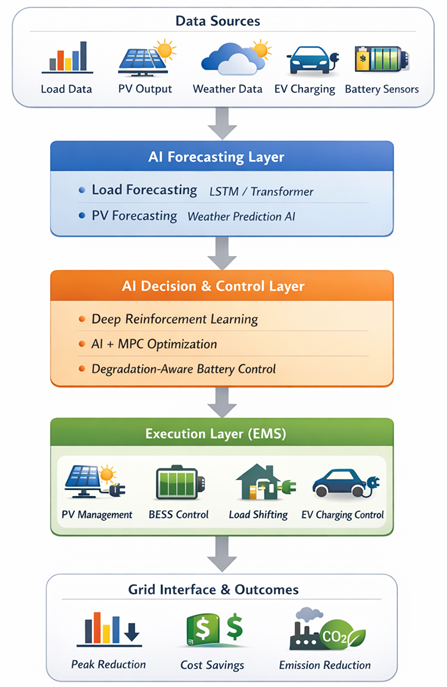
Figure 1. Architecture of the AI-Based PV–Battery Energy Storage System for Peak Shaving and Load Management.
The system continuously collects data from smart meters, PV inverters, battery management systems, weather services, and electricity tariffs. This data feeds an AI forecasting layer, where deep learning models such as LSTM or Transformer networks predict short-term electrical load and PV generation. Based on these predictions, an AI decision and control layer determines optimal charging and discharging actions for the battery while respecting operational constraints. Finally, an Energy Management System (EMS) executes control commands to coordinate PV generation, battery operation, flexible loads, and grid interaction.
How AI Enables Predictive Peak Shaving
Unlike reactive control, AI enables predictive peak mitigation. By learning temporal patterns in historical and real-time data, AI models can identify upcoming peak demand periods hours in advance. This allows the system to store excess PV energy proactively and reserve battery capacity for critical peak intervals.
Reinforcement learning-based controllers further enhance performance by continuously improving dispatch strategies through interaction with the environment. Hybrid AI–optimization approaches ensure that physical constraints such as battery state-of-charge limits, power balance requirements, and user comfort are always respected. Importantly, battery degradation is explicitly considered, ensuring that peak shaving benefits do not come at the expense of reduced battery lifetime.
PV–BESS Peak Shaving Operation
The operational principle of the proposed system is illustrated in Figure 2, which shows how PV generation and battery storage interact to mitigate peak demand.
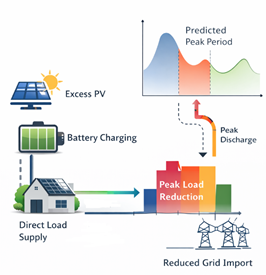
Figure 2. Operational Principle of PV–BESS-Based Peak Shaving and Peak Demand Mitigation.
During periods of high PV generation and low demand, excess solar energy is stored in the battery. When a peak demand period is predicted—typically in the evening or during high commercial activity—the battery discharges to supply local loads. This reduces grid import, flattens the load profile, and effectively shaves the peak. As a result, demand charges are reduced and grid stress is minimized.
Key Benefits of AI-Based Peak Shaving
AI-driven PV–BESS peak shaving delivers benefits across multiple dimensions. From a grid perspective, it reduces peak demand, alleviates congestion, and improves reliability. For consumers and facility operators, it lowers electricity bills by reducing demand charges and increasing PV self-consumption. From an environmental standpoint, it enables higher renewable energy utilization and reduces dependence on fossil-fuel-based peaking plants.
Practical evaluations show that AI-based peak shaving systems can achieve 15–40% peak demand reduction, depending on storage capacity, load flexibility, and forecasting accuracy. Additionally, degradation-aware battery control can significantly extend battery lifetime, improving overall system economics.
Applications and Future Outlook
AI-based PV–BESS peak shaving is applicable to smart homes, commercial and industrial facilities, EV charging stations, and microgrids. It is particularly well suited for integrating second-life EV batteries, offering a sustainable and cost-effective energy storage solution.
Future developments will likely incorporate federated learning, digital twins, and real-time grid signals to further enhance scalability and robustness. As AI models become more explainable and reliable, their adoption in utility-scale and mission-critical energy systems will continue to grow.
Conclusion
AI-driven peak shaving using PV and Battery Energy Storage Systems represents a major advancement in intelligent energy management. By combining accurate forecasting, adaptive control, and degradation-aware optimization, AI enables proactive peak mitigation that reduces costs, enhances grid reliability, and supports the transition toward low-carbon power systems.