
Introduction
Second-life electric vehicle (EV) batteries are gaining global attention as a practical solution to growing energy storage needs and sustainability challenges. With the rapid expansion of electric mobility, large numbers of lithium-ion batteries are reaching the end of their automotive service life. However, retirement from an EV does not mean the battery is no longer useful. In most cases, EV batteries retain 70–80% of their original capacity, making them highly suitable for less demanding stationary energy storage applications. Second-life utilization extends battery lifespan by five to ten years while reducing environmental and economic costs.
What Are Second-Life EV Batteries?
Second-life EV batteries refer to lithium-ion batteries that have been removed from electric vehicles and repurposed for stationary energy storage. These batteries no longer meet the high-performance requirements of driving, such as long range and fast charging, but remain fully functional for applications where power demand is lower and more predictable. This Figure 1 illustrates the complete lifecycle of an electric vehicle (EV) battery from manufacturing to end-of-life management, highlighting both first-life and second-life usage durations. A newly manufactured battery pack is first deployed in an electric vehicle, where it typically serves for 8–10 years or until its state of health declines to around 70–80% and no longer meets automotive performance requirements. At this stage, the used battery pack is removed from the vehicle and directed toward one of three possible pathways.
If the battery remains structurally intact and electrically safe, it can be sent to a battery refurbishing company for testing, reconfiguration, and repurposing. The refurbished battery is then deployed in second-life stationary energy storage applications, such as renewable energy storage, backup power systems, or grid support, where it can provide an additional 5–10 years of service under less demanding operating conditions. After completing its second-life application, the battery is directed to recycling, where valuable materials are extracted and reprocessed for use in new battery manufacturing.
Alternatively, batteries that are severely degraded, damaged, or located in regions lacking appropriate reuse or recycling infrastructure may be disposed of, although this pathway represents a loss of material value and environmental benefit. Overall, the figure demonstrates how combining first-life EV use and second-life stationary storage can extend the total functional lifetime of a lithium-ion battery to 15–20 years, significantly improving resource efficiency and supporting circular economy principles.
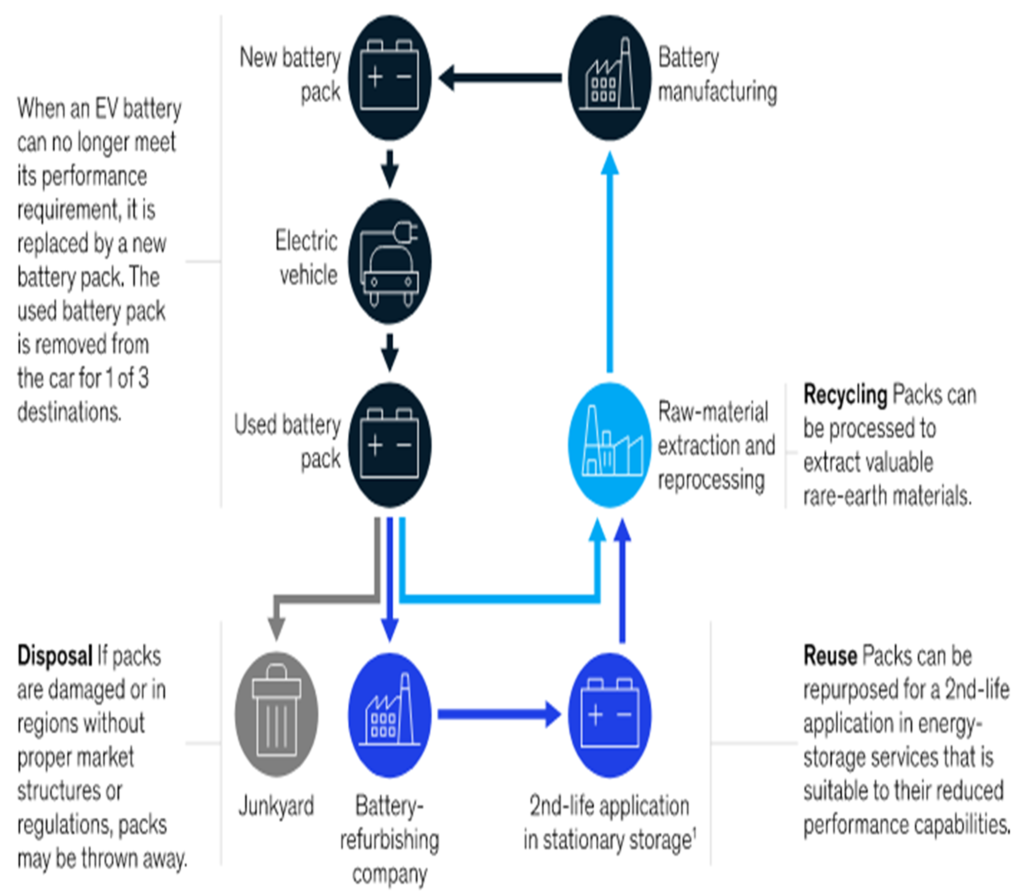
Figure 1: Lifecycle of an EV Battery
Why EV Batteries Retire from Vehicles
EV batteries are typically retired when their state of health drops below approximately 80%. At this level, reduced driving range and performance become noticeable to vehicle owners, even though the battery still has significant usable capacity. Safety margins, warranty conditions, and consumer expectations further accelerate battery replacement. In contrast, stationary applications do not require high power density or rapid response, making second-life batteries a technically viable and efficient solution.
Environmental Benefits of Second-Life Batteries
One of the strongest advantages of second-life EV batteries is their environmental impact. Extending battery life reduces the volume of battery waste and delays recycling processes that are both energy-intensive and costly. By reusing existing batteries, the demand for newly mined materials such as lithium, cobalt, and nickel is reduced, lowering greenhouse gas emissions and minimizing ecological damage associated with mining and processing.
Figure 2 illustrates the broad socio-economic and environmental benefits generated by the deployment of second-life electric vehicle (EV) batteries across multiple stakeholder groups. At the national level, second-life battery adoption contributes to an enhanced green state image by demonstrating commitment to sustainability, circular economy practices, and climate action goals. From an environmental perspective, the reuse of retired EV batteries significantly reduces CO₂ emissions by lowering the demand for new battery production and minimizing premature disposal.

Figure 2: Multi-Stakeholder Benefits of Second-Life EV Battery Utilization
For industry stakeholders, second-life battery utilization supports the long-term sustainability of the EV and energy storage sectors by extending asset lifetimes, reducing costs, and creating new business opportunities in battery refurbishment and energy services. In academia, second-life applications open new research pathways in battery diagnostics, repurposing technologies, safety assessment, and lifecycle optimization, particularly in addressing battery waste management challenges. At the societal level, second-life battery systems improve the quality of rural and underserved communities by enabling reliable, affordable energy access, supporting microgrids, and enhancing overall living standards. Collectively, the figure highlights how second-life EV batteries create integrated value across nation, environment, industry, academia, and society.
Economic Advantages and Cost Savings
Second-life EV batteries offer a significant cost advantage over new lithium-ion batteries. Because the most expensive phase of a battery’s lifecycle is manufacturing, reusing batteries can reduce energy storage system costs by 30–60%. This cost reduction makes energy storage more accessible to households, small businesses, and developing regions, accelerating adoption of renewable energy technologies and distributed power systems.
Supporting Renewable Energy Integration
The integration of renewable energy sources such as solar and wind requires reliable energy storage to manage intermittency. Second-life EV batteries enable the storage of excess renewable electricity during periods of high generation and release it when demand exceeds supply. This improves grid stability, reduces reliance on fossil-fuel-based backup generation, and supports higher penetration of clean energy across both centralized and decentralized power networks.
Applications of Second-Life EV Batteries
Second-life EV batteries are increasingly used in a variety of stationary applications, including residential solar storage systems, commercial and industrial buildings, telecom base stations, EV charging infrastructure, backup power systems, and off-grid microgrids. These applications benefit from the moderate performance requirements and cost-effectiveness of second-life batteries, as summarized in Table 1, which compares new and second-life EV batteries across key technical and economic parameters.
Table 1 : Comparison of New and Second-Life EV Batteries
| Parameter | New EV Battery | Second-Life EV Battery |
| Cost | High | Low (30–60% cheaper) |
| State of Health | 100% | 70–80% |
| Energy Density | High | Moderate |
| Expected Lifetime | 10–15 years | 5–10 years |
| Environmental Impact | High (new materials) | Low (reuse-based) |
| Ideal Use Case | Vehicles, fast response | Stationary storage |
Challenges and Technical Considerations
Despite their potential, second-life EV batteries present several challenges. Variations in battery chemistry, design, and degradation history complicate system integration and performance prediction. Safety, reliability, and accurate state-of-health estimation remain critical concerns. To address these issues, ongoing research focuses on advanced battery diagnostics, artificial intelligence–based health estimation, standardized testing protocols, and adaptive battery management systems.
Conclusion
As global EV adoption continues to rise, the availability of retired EV batteries will increase dramatically. Second-life EV batteries are poised to become a cornerstone of sustainable energy systems by reducing lifecycle emissions, lowering storage costs, and enabling wider access to clean energy. By transforming what was once considered waste into a valuable energy resource, second-life EV batteries demonstrate that the future of energy is not only electric, but also circular, efficient, and sustainable.