
The rapid growth of electric vehicles (EVs) is creating a new and often overlooked opportunity: the reuse of retired EV batteries for stationary energy storage. Although EV batteries are typically removed once their capacity drops below 70–80%, they still retain substantial usable energy. When repurposed as Second-Life Battery Energy Storage Systems (SL-BESS), these batteries can deliver reliable, cost-efficient storage for residential solar photovoltaic (PV) systems, transforming the way communities manage their energy.
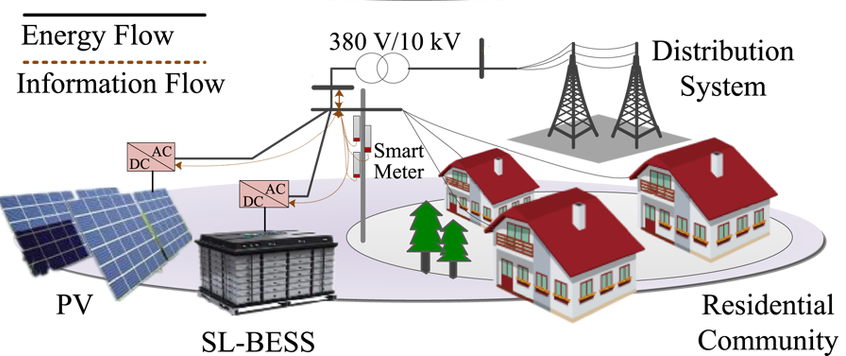
Figure 1 : Schematic of a Residential Community Integrated with PV-Powered Second-Life Battery Energy Storage System (SL-BESS)
As shown in the Figure 1, a typical configuration integrates rooftop or ground-mounted PV arrays with an SL-BESS through bidirectional converters. The system continuously monitors solar generation, household demand, and grid conditions through smart meters, enabling coordinated energy and information flow. This synergy allows households to store excess midday solar energy and deploy it later during evening peaks effectively flattening demand curves and reducing reliance on the grid.
One of the most compelling advantages of second-life batteries is cost reduction. Traditional lithium-ion storage remains expensive for many homeowners, limiting the adoption of full PV-plus-storage systems. In contrast, SL-BESS units can be 40–60% cheaper due to their pre-used nature, making storage-augmented solar systems far more accessible. This cost benefit can accelerate clean-energy adoption in residential communities, especially in emerging economies where affordability is critical.
Beyond economics, SL-BESS supports grid resilience and stability. With more distributed PV systems feeding into the grid, fluctuations in generation can lead to instability. Second-life batteries help buffer these variations by absorbing excess generation and releasing stored energy during low-solar intervals or grid stress events. Homeowners benefit from reduced peak-hour tariffs and improved power quality, while utilities gain decentralized support for frequency and voltage stabilization.
Smart meters play a central role in optimizing this hybrid energy ecosystem. By enabling two-way communication, smart meters allow the SL-BESS to participate in demand response, time-of-use pricing, and even future energy trading frameworks. Energy flows are managed dynamically: the system can charge when electricity is abundant and cheap, and discharge when demand spikes. This intelligent control strengthens both sustainability and economic returns.
From an environmental perspective, repurposing EV batteries significantly reduces e-waste and extends the life cycle of valuable materials such as lithium, nickel, and cobalt. This contributes directly to circular-economy goals and lowers the environmental footprint of both the EV and renewable-energy sectors.
In summary, second-life EV batteries represent a practical, scalable, and sustainable solution for enhancing solar-powered residential communities. By integrating SL-BESS with PV systems supported by smart meters and grid-interactive control households can reduce energy costs, bolster grid resilience, and contribute to a cleaner, circular energy future. As EV adoption accelerates globally, the potential for second-life energy storage in homes and communities is not just promising it is transformative.